
Water treatment for heating systems
Scale, sludge and corrosion all start with the water inside your system. We test it, treat it and keep it clean, so boilers, heat pumps and pipework last longer and cost less to run.
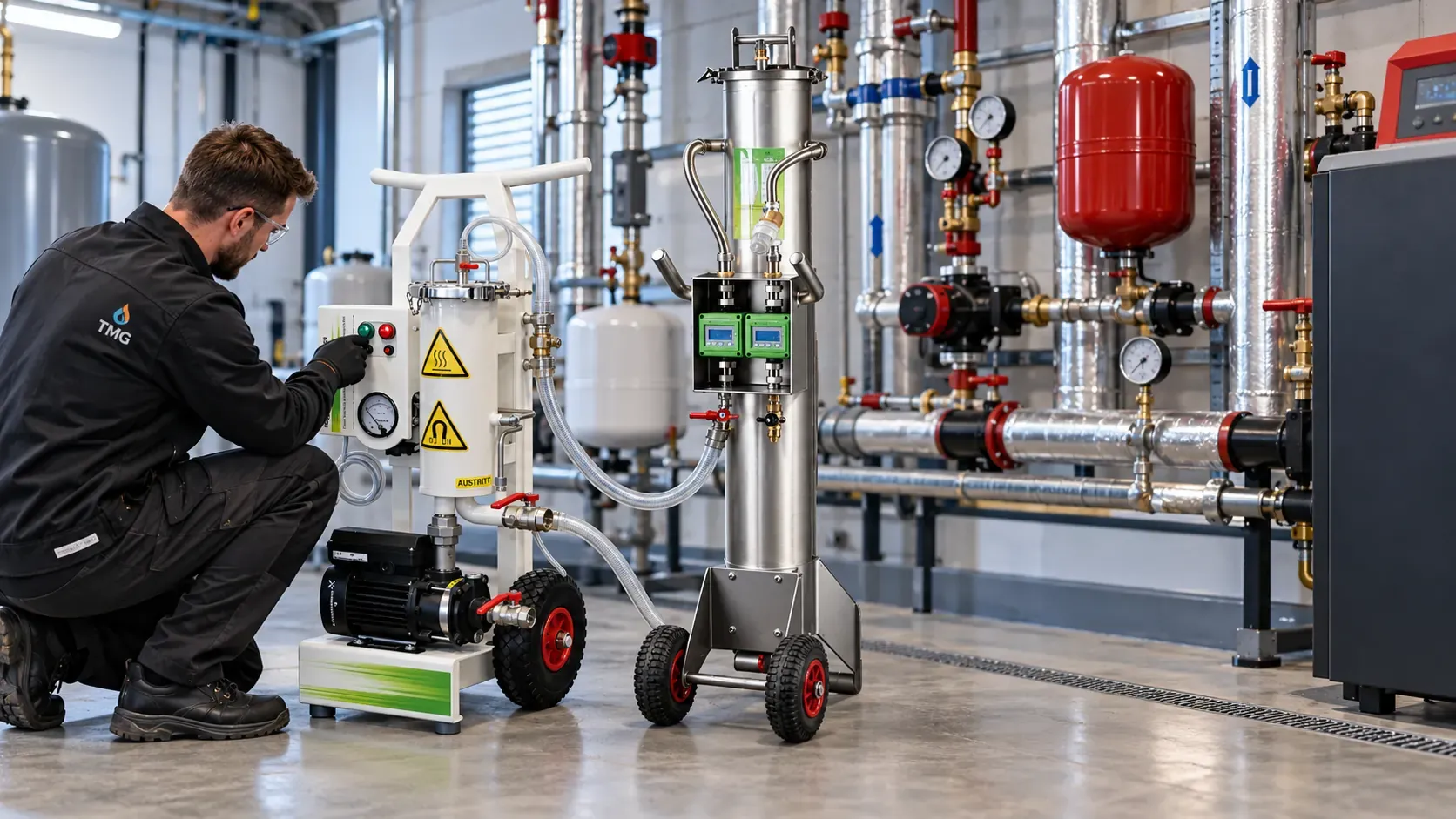
Modern boilers are very efficient, but they have little tolerance for poor water. Poor system-water quality can reduce heat transfer, restrict flow and increase the load on pumps and boilers. Left untreated, the minerals in the water go on to cause scale, corrosion and breakdowns. As plumbers and heating contractors specialising in heating water quality, TMG Plumbing & Heating Services provides water treatment for homes across Waterford and the South East, and for commercial buildings nationwide.
Demineralisation
Mineral-free system water for boilers, radiators and underfloor heating.
Read more ↓
Commercial demineralisation
Mobile units, refill stations and water regulators for larger buildings.
Read more ↓
Water testing
Know what is in your system water before and after treatment.
Read more ↓
Chemical-free pipe cleaning
Air-pulse and ultrasonic cleaning, with no chemicals.
Read more ↓
Demineralisation
Demineralising removes calcium, magnesium and other dissolved solids from the water circulating in your heating system. It reduces the risk of scale and corrosion without adding chemicals, and works alongside good filtration and inhibitor where needed.
Stops limescale
Scale coats heat exchangers and chokes pipework, so the system burns more energy for the same heat. Removing the minerals stops it forming.
Slows corrosion
Mineral-rich water conducts electricity, which speeds up rust inside radiators and pumps. Demineralised water turns that process right down.
Helps meet manufacturer water-quality requirements
Many manufacturers set water-quality limits, often based on VDI 2035. Treated water helps keep the system within them.
Our 5-step process
- 1
Initial analysis
We test the heating water for conductivity, pH and total hardness. If the readings are outside the recommended limits, we recommend treatment.
- 2
Cleaning the system
On an existing system we remove sludge and magnetite first, circulating a cleaner or flushing until the water runs clear.
- 3
Power flushing
Each section of the system is power flushed on its own, so no debris is left behind before refilling.
- 4
Demineralisation
The system is refilled through professional demineralising equipment, so minerals are removed before the water goes in.
- 5
Regulation and final testing
We test the water again to confirm it meets the standard. Checks every six months keep it there.
Commercial demineralisation
Large heating systems hold thousands of litres of water and are topped up regularly, so poor water quality costs more and does more damage. We power flush and demineralise commercial systems in a single, controlled process, then fit equipment that keeps the water right between visits.
Mobile treatment units
Ion-exchange resin swaps calcium and magnesium for hydrogen and hydroxide ions, demineralising and filtering the water in one step.
Demineralising cartridges
Fitted to a refill station for ongoing protection. Easy to replace, so treated water is always on hand.
Refill stations
Top the system up with treated water only, so fresh minerals and contaminants never get back in.
Heating water regulators
Chemical-free corrosion protection fitted permanently to the system: removes gases, helps stabilise pH and captures magnetite and sludge.
What is a Heating Water Regulator?
A Heating Water Regulator gives the system chemical-free corrosion protection. Fitted permanently, it removes oxygen and other gases, helps stabilise the pH of the water and captures magnetite and sludge, working continuously while the system runs. It works well alongside a refill station, so any top-up water is demineralised too.
What is a refill station?
A refill station tops the system up with treated, demineralised water, usually through a demineralising cartridge. Only purified water enters the system, so pressure stays stable and fresh minerals never get back in.
We treat systems in hospitals, hotels, schools and colleges, offices, factories, care homes, leisure centres, apartment complexes and public buildings, anywhere in Ireland. See our commercial work →
Water testing
You can't treat what you haven't measured. Every job starts with a test of the system water, and we test again after treatment to prove the result.
For commercial systems we can send samples to an independent laboratory for a full analytical report, which gives facilities teams a clear record of water quality over time.
Conductivity
How much dissolved mineral is in the water.
pH
Water that is too acidic or alkaline attacks metals.
Total hardness
The calcium and magnesium that form scale.
Six-monthly checks
Regular retesting keeps treated water within limits.
Chemical-free pipe cleaning
Not every system can take cleaning chemicals, and many sites would rather avoid them altogether. Where they suit the system, we offer cleaning methods that use only air, water or sound to remove scale, sludge and biofilm from pipework and heat exchangers. Some systems will still need water treatment afterwards.
Air-pulse cleaning
Controlled pulses of compressed air are injected into water flowing through the pipe. The air and water create strong turbulence along the pipe wall, which scours off deposits and biofilm and carries them out of the system.
- •No chemicals and little water
- •Suits pipework, risers and heat exchangers
- •Can be used on drinking water pipework
Ultrasonic (sound wave) cleaning
Transducers clamped to the outside of the pipe or heat exchanger send sound waves through the metal. The vibration breaks up existing deposits and stops new fouling building up, with nothing added to the water.
- •Can often run while the system stays in use, depending on the site
- •No chemicals and no dismantling
- •Suits heat exchangers and process pipework
These methods suit hospitals, pharmaceutical and food sites, data centres and district heating, where downtime and chemical use both need to be kept to a minimum. We survey the system first and recommend the method that fits.
Download our guides
Free PDFs to read now or keep for later.
Frequently asked questions
Why does the water in a heating system need treating?
Tap water carries calcium, magnesium and other dissolved solids. Inside a heating system these form scale and speed up corrosion, which cuts efficiency, causes cold spots and shortens the life of the boiler, pump and radiators.
What is VDI 2035?
VDI 2035 is the German guideline that many boiler and heat pump manufacturers base their limits on for heating water, covering hardness, conductivity and pH. We test and treat heating water with reference to VDI 2035 and the water-quality requirements specified by the equipment manufacturer, which helps keep the system efficient.
Does my system need to be power flushed before demineralising?
Yes. Demineralised water only protects a clean system, so an existing system is cleaned and power flushed first. During the flush the water is passed through a mobile demineralising unit.
How often should heating water be tested?
We recommend a test when the system is filled or treated, and then every six months. Commercial systems with frequent top-ups may need checking more often.
Is chemical-free pipe cleaning suitable for every system?
It depends on the pipework, the type of deposit and whether the system can be taken offline. We survey the system first and recommend the method that suits it.
Find out what's in your system water
Book a water analysis, or talk to Tony about the right treatment for your building.